Pooh Bear Poem About Dying the Day Youre Born Again
AA Milne and the curse of Pooh comport
(Image credit:
ZUMA Press, Inc./Alamy
)
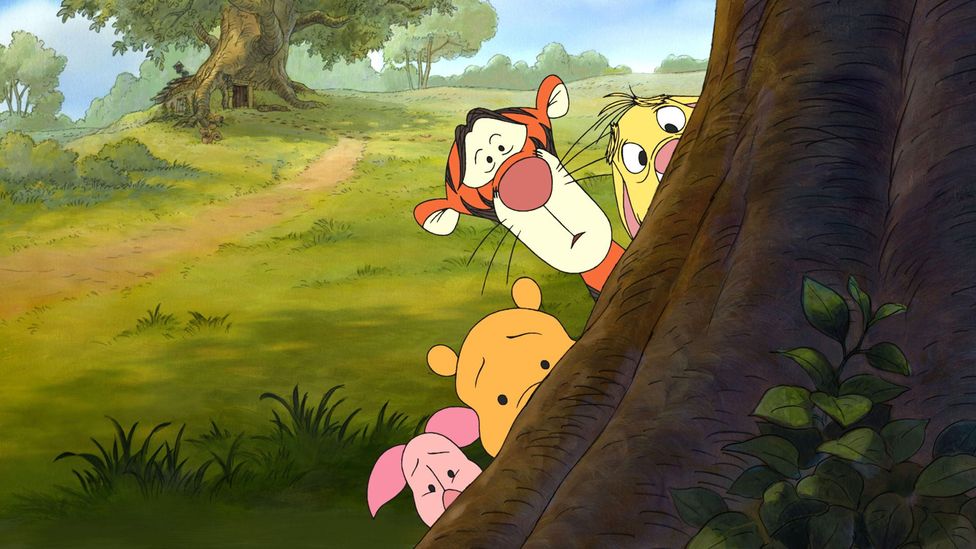
Both AA Milne and his son Christopher Robin grew to resent the bear – and the books – for the enormous impact they had on their lives
S
60 years ago, children – and their parents – lost one of the almost love geniuses of children'due south literature: AA Milne, the creator of Winnie the Pooh.
"I suppose that every one of us hopes secretly for immortality," Milne wrote in 1926 before his Pooh books swept the world.
Immortality he received – simply non for the reasons he wanted.
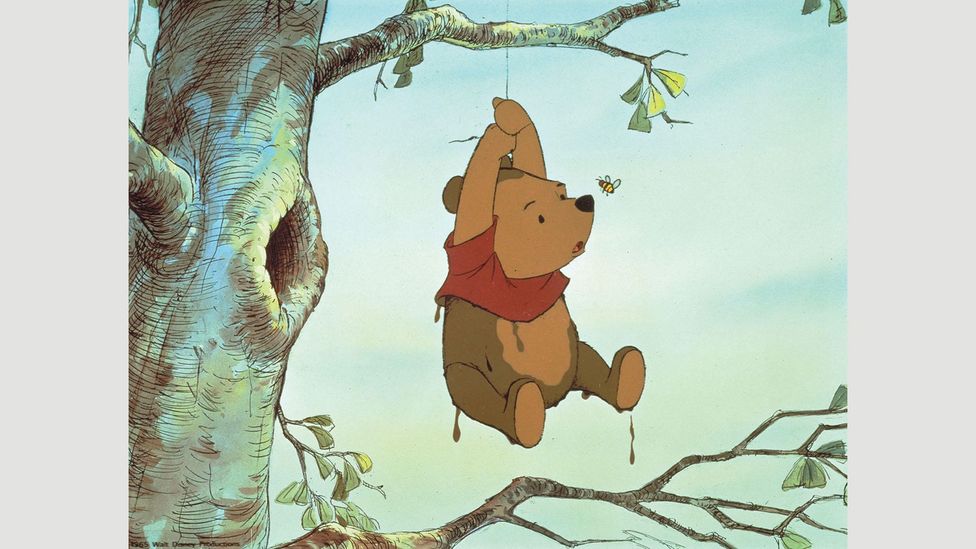
AA Milne wanted to leave more of a legacy than the 'behave of very little brain', shown hither in the 1977 Disney film (Credit: ZUMA Press, Inc./Alamy)
Pleased every bit dial
Over the course of his lifetime, Milne wrote 7 novels, five nonfiction books and 34 plays, along with numerous stories and articles. He worked as editor of Granta and assistant editor of Dial. His cocky-stated aim: to write whatever he wished. As a young writer, when Punch finally accepted one of his pieces, he had been elated. "I had proved that I could earn a living by writing. I would be editor of Punch one solar day. I was the happiest homo in London," he wrote in his 1939 autobiography – tellingly titled Information technology's Too Late Now.
Of course, Milne would also write the 4 children's books that made up the Winnie the Pooh serial as well equally 2 poetry collections, When We Were Very Immature and Now We Are Six. The children's books added up to just 70,000 words, the length of an average novel. But their enormous fame erased the memory of all the piece of work he'd already washed.
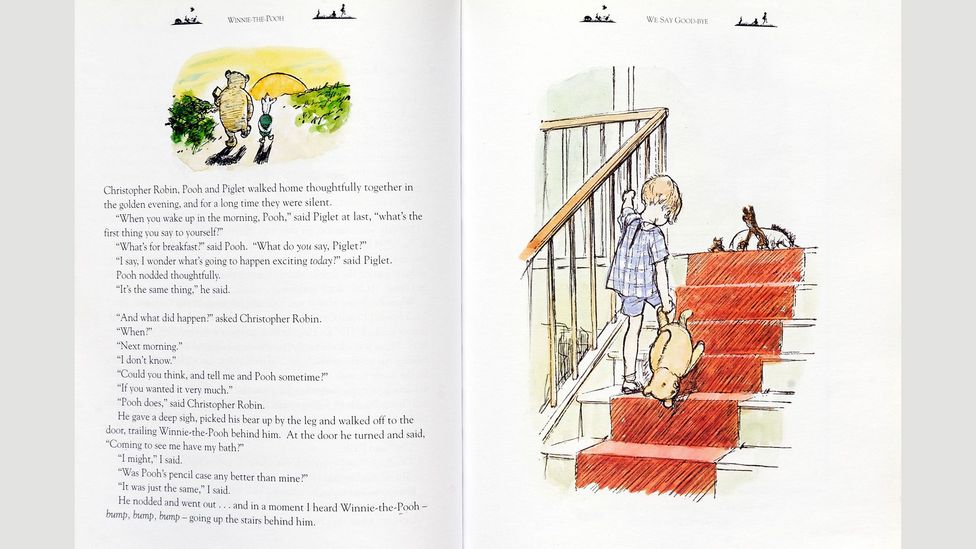
Milne's Winnie the Pooh books added up to just lxx,000 words – the length of an average novel (Credit: CBW/Alamy)
The success of the Pooh stories also undermined the reception of the non-juvenile piece of work Milne wrote later. "It seems to me now that if I write anything less realistic, less straightforward than 'The cat sat on the mat', I am 'indulging in a whimsy'," Milne wrote in the introduction to his play The Ivory Door in 1928. "Indeed if I did say that the cat sat on the mat (as well it might), I should be accused of being whimsical about cats; non a existent cat, only just a little make-believe pussy, such as the writer of Winnie-the-Pooh invents and then charmingly for our contentment."
His collaborator, the Punch political cartoonist turned Pooh illustrator EH Shepard, felt the same. Before his death, he chosen Pooh "that light-headed erstwhile behave" and expressed regret that he'd e'er taken part.
After the Winnie the Pooh books, Milne tried to write for Dial over again. But not even his former readers would take him back. "His skill had not deserted him, but his public had; and somewhen the editor, EV Knox, wrote to tell him so," his son Christopher wrote in his 1974 memoir The Enchanted Places. "We each had our sorrows."
The existent boy
Afterwards all, Milne wasn't the but one who struggled with Winnie the Pooh's fame. As the inspiration for Christopher Robin, in some ways Milne's son was even more famous than his father. Every bit ane Town and Country commodity put information technology in a photograph caption, Milne was an "English playwright. Children'due south poet laureate past divine right of whimsy. His plays have been successfully produced in New York. And he is the father of Christopher Robin."
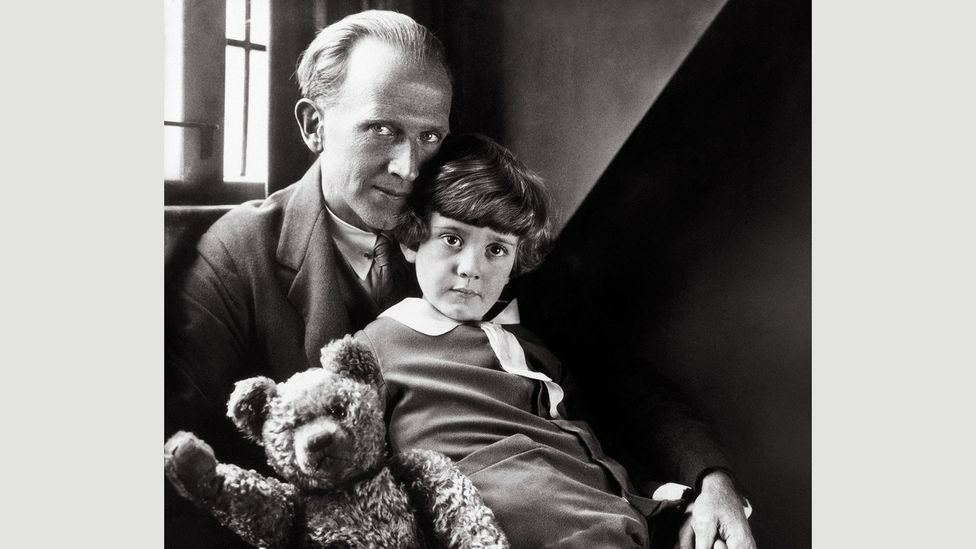
Milne with his son Christopher and the well-loved bear in 1926 (Credit: Pictorial Press Ltd/Alamy)
The family didn't exactly shield Christopher from the publicity. He was given the fan messages that children wrote to him and would laboriously pen responses with his nanny's help. Many photographs were taken of him with his father, and also lone. When he was seven, he participated in audio recordings that were done of the books – exploitation, his cousin afterwards said, that showed "the unacceptable face up of Pooh-dom". The adjacent year, Christopher performed before 350 guests at a party, reciting parts of the books and singing the song The Friend. In 1929, he acted in a pageant based on the stories.
Information technology was around then that Milne decided to finish writing children'due south books. He felt it was time he "said cheerio to all that" in order to change literary direction once more, something he'd been then expert at in the past. But a large part of the reason, he wrote, was besides his "amazement and disgust" at his kid'due south outsized fame.
"I experience that the legal Christopher Robin has already had more publicity than I desire for him," Milne wrote. "I do not want CR Milne to ever wish that his name were Charles Robert."
In 1930, Christopher went off to boarding schoolhouse. It was the beginning, he wrote later, of that "love-hate human relationship with my fictional namesake that has continued to this day." (The other boys ribbed him mercilessly. His neighbours played the gramophone record he'd performed on over and over until, finally, they got bored with the joke and gave him the record. Christopher smashed it to pieces.
Perfect strangers believed they knew – and could estimate – Christopher. On the 60th ceremony of the start Winnie the Pooh volume, critic Chris Powling wrote, "Was there ever a more detestable child than Christopher Robin?"
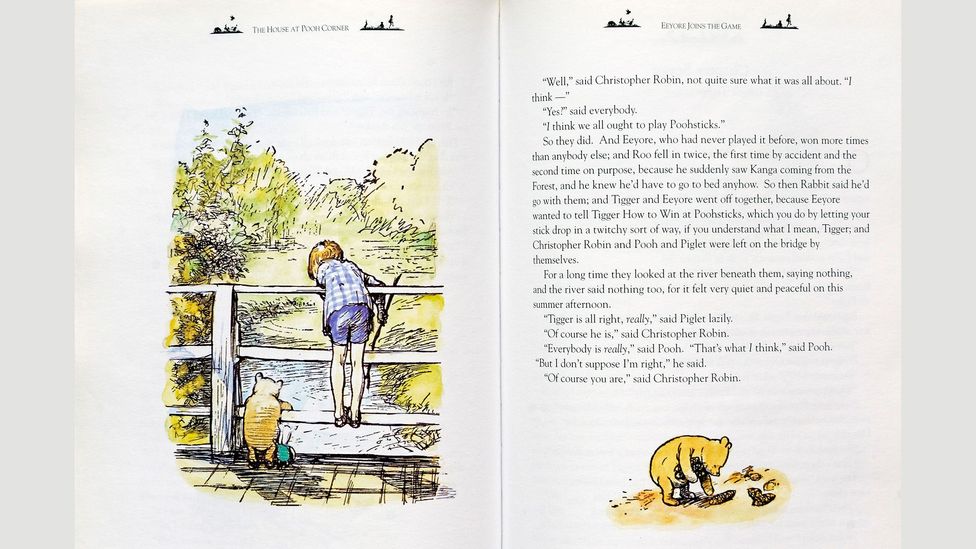
Shepard'due south illustrations were the verbal likenesses of the real-life Christopher Robin, shown here in the 1928 volume the House at Pooh Corner (Credit: CBW/Alamy)
Fifty-fifty more than galling must take been that, as Christopher insisted in his memoirs, the opinions were based on a character that wasn't actually him. His family unit didn't even call him Christopher Robin, but his nickname Billy. Both father and son emphasised that Christopher was not the literary grapheme. Just not everyone saw that stardom – with reason, perchance, since even the original Shepard illustrations were verbal likenesses of the real-life boy.
It was only after a frustrated period of fruitless job-searching after university that Christopher came to feel real resentment – toward both the stories and his begetter. "He had fabricated his own way by his ain efforts and he had left behind him no path that could be followed. Merely were they entirely his own efforts? Hadn't I come into information technology somewhere?" Christopher wrote. "In pessimistic moments, when I was trudging London in search of an employer wanting to make use of such talents as I could offer, it seemed to me, almost, that my father had got to where he was by climbing upon my infant shoulders, that he had filched from me my skilful name and had left me with nothing but the empty fame of beingness his son."
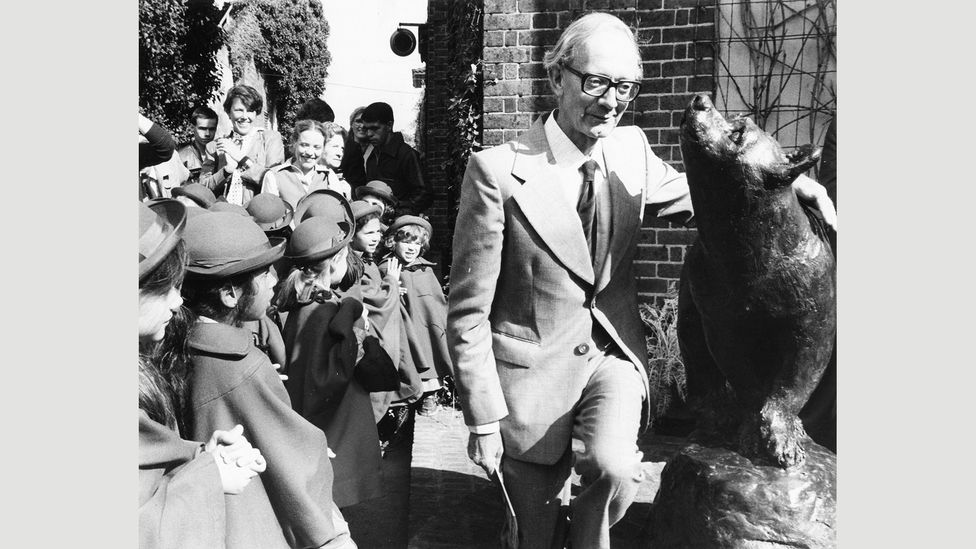
Christopher Robin Milne unveils a statue of a conduct at London Zoo in 1981 (Credit: Keystone/Hulton Archive/Getty)
Milne was just as stuck with Pooh and Christopher Robin as his son was. "I gave up writing children's books. I wanted to escape from them as I had once wanted to escape from Punch; as I have e'er wanted to escape. In vain," Milne wrote. "Equally a discerning critic pointed out: the hero of my latest play, God aid information technology, was 'just Christopher Robin grown up'.'"
When Milne wrote in The Business firm at Pooh Corner that "in that enchanted place on the top of the Forest, a petty boy and his Carry will always be playing", he didn't know how true it was. His legacy may not be quite as literary as he wanted. But even now, 60 years after his death, the male child and his conduct are still playing on the pages, and in the imaginations, of thousands of children worldwide.
This story is a office of BBC Great britain – a series focused on exploring this extraordinary island, one story at a time. Readers outside of the UK tin see every BBC Britain story by heading to the Britain homepage; you also can see our latest stories past following the states on Facebook and Twitter.
Source: https://www.bbc.com/culture/article/20160128-a-a-milne-and-the-curse-of-pooh-bear

Post a Comment for "Pooh Bear Poem About Dying the Day Youre Born Again"